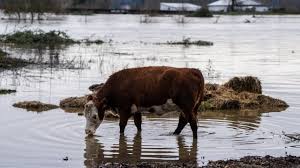
We on the Western side of the Cascade Mountains have received a bit more rain and melting snow than usual. Major rivers of jumped their banks and some of the most productive agricultural areas are under water. My hope for a dryer week is quickly evaporating and more flooding is one the way I fear.
Post flood, what dose a farmer need to consider?
If a produce field floods with water from outside the farm’s control (e.g., rivers, sewage overflow), the produce whose edible portion has come into contact with the floodwater must be considered adulterated and destroyed. This is due to the high risk of contamination by pathogens and chemicals, which cannot be removed by washing or cooking.
Immediate Actions
• Discard Affected Produce: Any edible crop, including root vegetables, that has come into direct contact with floodwaters must be discarded and kept separate from unaffected crops. This applies even if the produce has a durable rind, like squash or melons.
• Prevent Cross-Contamination:
◦ Mark the high-water line to clearly identify affected areas.
◦ Establish a minimum 30-foot buffer zone between flooded areas and adjacent areas to be harvested to prevent accidental cross-contamination, for example, during equipment turn-arounds.
◦ Thoroughly clean and sanitize all equipment, tools, and harvest bins that have come into contact with flooded soil or produce before using them in unaffected areas. Porous materials like wooden bins should ideally be discarded or meticulously cleaned and lined with plastic before reuse.
◦ Workers should wear protective clothing (rubber boots, gloves) when working in flooded fields and ensure these items are thoroughly cleaned or discarded before moving to clean areas.
• Document Losses: Before destroying crops, take photos and contact your crop insurance agent and local Farm Services Agency (FSA) representatives to document losses for potential financial assistance or insurance claims.
• Test Water Sources: If wellheads were submerged, the well water should be tested for contaminants like E. coli to ensure it is safe (potable) for future use in irrigation, washing, and personal hygiene.
Post-Flood Field Management
• Risk Assessment for Unaffected Crops: Crops near flooded areas but whose edible portions did not come in direct contact with floodwaters (e.g., staked tomatoes, sweet corn growing off the ground) require a careful, case-by-case risk assessment. Consider factors like the potential for splashing or windborne contamination, and if in doubt, discard.
• Replanting: Do not replant until the floodwater has fully receded and the soil has dried. A waiting period of at least 30-60 days is recommended before replanting with human food crops. If heavy metals or high contamination levels are suspected, waiting 60 days or more is best.
• Soil Remediation: Plant cover crops (e.g., winter rye, oats) to help stabilize the soil, manage erosion, and build organic matter. These cover crops should not be consumed but rather incorporated into the soil later. Soil testing after remediation is the only sure way to confirm the soil is suitable for future food crops.
• Organic Certification: Organic growers must inform and consult their certifier, as floodwaters might introduce prohibited substances that could affect certification status.
Resources
Food Safety for Flooded Fields – https://extension.umn.edu/growing-safe-food/food-safety-flooded-fields#:~:text=Quick%20facts,would%20be%20defined%20as%20pooling)
Produce Safety and Flood Resources – https://ucsmallfarmfoodsafety.ucdavis.edu/english/agricultural-water/potential-biological-hazards/produce-safety-and-flood-resources#:~:text=Crops%20affected%20by%20floods%20should,what%20factors%20guide%20decision%20making
Frequently Asked Questions About Handling Flooded Produce – https://www.uvm.edu/vtvegandberry/factsheets/Flooded_Produce_FAQ.pdf